|
Amway
is a USA based multi-level marketing
company. Amway is short for "American
Way". Amway sells health, beauty,
and home care products. The company
was founded in 1959 by Jay Van Andel
and Richard DeVos.
It's
based in Ada, Michigan. Amway and
its subsiduaries companies such as
Alticor, reported sales of $8.8 billion
in 2018. Amway does business through
a number of affiliated companies in
more than a hundred countries and
territories.
Amway
is considered the largest network
marketing company in the world. This
is mainly due to the fact that it's
one of the oldest network marketing
companies. So it's had several decades
to gradually expand it's operations
worldwide.
On
this page we will cover all the various
aspects of the Amway Corp.
|
|
|
|
AMWAY
OVERVIEW:
Amway
Corp
 |
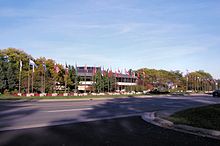
Headquarters
in Ada, Michigan
|
| Industry |
Multi-level
marketing |
| Founded |
November 9,
1959 (60 years ago) (1959-11-09) |
| Founder |
- Richard
DeVos
- Jay
Van Andel
|
| Headquarters |
Ada,
Michigan, United States |
|
Area
served
|
Worldwide |
|
Key
people
|
- Steve
Van Andel (Co-Chairman)
- Doug
DeVos (Co-Chairman)
- Milind
Pant (CEO)
|
| Products |
Amway
Home, Glister, G&H, Nutrilite, Artistry,
AmwayQueen, eSpring, Atmosphere, XS Energy |
| Revenue |
US$
8.8 billion (2018) |
|
Number
of employees
|
16,000+ |
| Parent |
Alticor |
| Website |
www.amwayglobal.com |
 HISTORY:
Jay Van Andel and Richard DeVos had been friends
since school days and business partners in various
endeavors, including a hamburger stand, an air
charter service, and a sailing business. In 1949,
they were introduced to the Nutrilite Products
Corporation by Van Andel's second cousin Neil
Maaskant. DeVos and Van Andel signed up to become
distributors for Nutrilite food supplements in
August. They sold their first box the next day
for $19.50, but lost interest for the next two
weeks. They traveled to Chicago to attend a Nutrilite
seminar soon after, at the urging of Maaskant,
who had become their sponsor. They watched promotional
filmstrips and listened to talks by company representatives
and successful distributors, then they decided
to pursue the Nutrilite business. They sold their
second box of supplements on their return trip
to Michigan, and rapidly proceeded to develop
the business further.
Earlier
in 1949, DeVos and Van Andel had formed the Ja-Ri
Corporation (abbreviated from their respective
first names) to import wooden goods from South
American countries. After the Chicago seminar,
they turned Ja-Ri into a Nutrilite distributorship
instead.[16] In addition to profits on each product
sold, Nutrilite offered commissions on sales made
by new distributors introduced to the company
by existing distributors—a system known as
multi-level marketing or network marketing. By
1958, DeVos and Van Andel had built an organization
of more than 5,000 distributors. However, they
and some of their top distributors formed the
American Way Association, or Amway, in April 1959
in response to concerns about the stability of
Nutrilite and in order to represent the distributors
and look for additional products to market.
Their
first product was called Frisk, a concentrated
organic cleaner developed by a scientist in Ohio.
DeVos and Van Andel bought the rights to manufacture
and distribute Frisk, and later changed the name
to LOC (Liquid Organic Cleaner). They subsequently
formed the Amway Sales Corporation to procure
and inventory products and to handle sales and
marketing plans, and the Amway Services Corporation
to handle insurance and other benefits for distributors.[19]
In 1960, they purchased a 50% share in Atco Manufacturing
Company in Detroit, the original manufacturers
of LOC, and changed its name to Amway Manufacturing
Corporation. In 1964, the Amway Sales Corporation,
Amway Services Corporation, and Amway Manufacturing
Corporation merged to form the Amway Corporation.
Amway
bought controlling interest of Nutrilite in 1972
and full ownership in 1994.
International
expansion
Amway expanded to Australia in 1971, to parts
of Europe in 1973, to parts of Asia in 1974, to
Japan in 1979, to Latin America in 1985, to Thailand
in 1987, to China in 1995, to Africa in 1997,
to India and Scandinavia in 1998, to Ukraine in
2003, to Russia in 2005[citation needed], and
to Vietnam in 2008.
In
2014, a Russian loyalty card program called "Alfa-Amway"
was created when Amway joined with Alfa-Bank.
Amway
was ranked as the 42nd largest privately held
company in the United States by Forbes in 2018,
and as the number one largest company on the Direct
Selling News Global 100 list in 2018.
Quixtar
Main article: Amway Global
In 1999 the founders of the Amway corporation
established a new holding company, named Alticor,
and launched three new companies: a sister (and
separate) Internet-focused company named Quixtar,
Access Business Group, and Pyxis Innovations.
Pyxis, later replaced by Fulton Innovation, pursued
research and development and Access Business Group
handled manufacturing and logistics for Amway,
Quixtar, and third-party clients.
The
main difference was that all "Independent
Business Owners" (IBO) could order directly
from Amway on the Internet, rather than from their
upline "direct distributor", and have
products shipped directly to their home. The Amway
name continued being used in the rest of the world.
After virtually all Amway distributors in North
America switched to Quixtar, Alticor elected to
close Amway North America after 2001. In June
2007 it was announced that the Quixtar brand would
be phased out over an 18- to 24-month period in
favor of a unified Amway brand (Amway Global)
worldwide.
In
2006, Quixtar published The Quixtar Independent
Business Owner Compensation Plan, in which the
company reported that the average monthly gross
income for "Active" IBOs was $115.
Global
markets
According to the Amway website, as of 2011 the
company operates in over 100 countries and territories,
organized into regional markets: the Americas,
Europe, greater China, Japan and Korea, and SE
Asia/Australia. Amway's top ten markets are China,
Korea, the United States, Japan, Thailand, Taiwan,
India, Russia, Malaysia and Italy.
In
2008, Alticor announced that two-thirds of the
company's 58 markets reported sales increases,
including strong growth in the China, Russia,
Ukraine and India markets.
Amway
Australia
See Amway Australia
Amway China
Amway China launched in 1995. In 1998, after abuses
of illegal pyramid schemes led to riots, the Chinese
government enacted a ban on all direct selling
companies, including Amway. After the negotiations,
some companies like Amway, Avon, and Mary Kay
continued to operate through a network of retail
stores promoted by an independent sales force.
China introduced new direct selling laws in December
2005, and in December 2006 Amway was one of the
first companies to receive a license to resume
direct sales. However, the law forbids teachers,
doctors, and civil servants from becoming direct
sales agents for the company and, unlike in the
United States, salespeople in China are ineligible
to receive commissions from sales made by the
distributors they recruit.
In
2006, Amway China had a reported 180,000 sales
representatives, 140 stores, and $2 billion in
annual sales. In 2007 Amway Greater China and
South-east Asia Chief Executive Eva Cheng was
ranked no. 88 by Forbes magazine in its list of
the World's Most Powerful Women. In 2008, China
was Amway's largest market, reporting 28% growth
and sales of 17 billion yuan (US$2.5 billion).
According to a report in Bloomberg Businessweek
in April 2010, Amway had 237 retail shops in China,
160,000 direct sales agents, and $3 billion in
revenue.
Amway
Brands
Amway's product line grew from LOC, with the laundry
detergent SA8 added in 1960, and later the hair
care product Satinique (1965) and the cosmetics
line Artistry (1968). Today Amway manufactures
over 450 products, with manufacturing facilities
in China, India and the US, as well as Nutrilite
organic farms in Brazil, Mexico and the US (California
and Washington State).[citation needed] Amway
brands include Artistry, Atmosphere, Body Blends,
Bodykey, Body Works, Clear Now, eSpring, Glister,
iCook, Legacy of Clean, Nutrilite, Peter Island,
Perfect Empowered Drinking Water, Personal Accents,
Ribbon, Satinique, Artistry Men and XS.
In
2018, nutrition and wellness products were 52%
of total sales, and beauty and personal care products,
26%.
Household
cleaners
Amway is best known in North America for its original
multi-purpose cleaning product LOC, SA8 laundry
detergent, and Dish Drops dishwashing liquid.
In the January 2007 issue of Consumer Reports,
SA8 with Bioquest was rated the best-performing
laundry detergent. Consumer Reports did, however,
criticize SA8's pricing, a situation which was
disputed by Amway. Consumer Reports conducted
blind testing of detergents in 2010 and ranked
versions of Amway's Legacy of Clean detergents
9th and 18th of 20 detergents tested. Consumer
Reports program manager Pat Slaven recommended
against buying the products because consumers
can "go to the grocery store and get something
that performs a whole lot better for a whole lot
less money".
Health
and beauty
Amway's health and beauty brands include Artistry,
Satinique, Hymm, Body Series, Glister, Moiskin
(South America), Nutrilite, Nutriway (Scandinavia
and Australia/New Zealand), Attitude (India),
eSpring, Atmosphere and iCook as well as XL and
XS Energy drinks. Other Amway brands that were
discontinued or replaced include Tolsom, Eddie
Funkhouser New York, or beautycycle (Eastern Europe).
Artistry
Main article: Artistry (cosmetics)
Amway's Artistry products include skin care, cosmetics,
and anti-aging creams and serums. In 2011, Artistry
brand reached sales of $2.8 billion.
Nutrilite
Main article: Nutrilite
Amway's largest-selling brand is the Nutrilite
range of health supplements (marketed as Nutriway
in some countries), and in 2008 Nutrilite sales
exceeded $3 billion globally. In 2001, NSF International
issued its first five dietary supplement certifications
to Nutrilite.
In
2011, Nutrilite brand of vitamins and dietary
supplements led Amway's sales, totaling almost
$4.7 billion. According to Euromonitor International,
in 2014, Nutrilite was the world's No. 1 selling
vitamins and dietary supplements brand. In 2015,
it was reported that according to Euromonitor
International, Amway was the largest vitamin and
dietary supplement vendor in China, with 11% of
a market that generated 100 billion yuan ($15.6
billion) in annual sales. In 2015, it was reported
that according to China Confidential consumer
brands survey, Amway Nutrilite was the most popular
vitamin and dietary supplement brand in China.
In
January 2009, Amway announced a voluntary recall
of Nutrilite and XS Energy Bars after learning
that they had possibly been manufactured with
Salmonella-contaminated ingredients from Peanut
Corporation of America. The company indicated
that it had not received any reports of illness
in connection with the products.
In
2012, the Center for Science in the Public Interest
(CSPI), accused Amway of making unsubstantiated
and illegal claims about Nutrilite Fruits &
Vegetables 2GO Twist Tubes and threatened to launch
a class action lawsuit against the company unless
it took remedial action. Amway responded that
the claims made about the products were properly
substantiated and that they did not plan to change
the product's labeling but nevertheless would
review the statements that CSPI has questioned.
CSPI later reported that Amway had agreed to changing
product labels by the end of 2014.
eSpring
Amway's eSpring water filter was introduced in
2000. According to Amway, it was the first system
to combine a carbon block filter and ultraviolet
light with electronic-monitoring technology in
the filter cartridge and it became the first home
system to achieve certification for ANSI/NSF Standards
42, 53, and 55. According to Amway, eSpring was
the first water treatment system to receive certification
for all fifteen NSF/ANSI 401 contaminants which
include pharmaceuticals, pesticides and herbicides.
The company also claims that, in addition to these
15 contaminants, eSpring is certified for more
than 145 potential contaminants, including lead
and mercury.
eSpring
was the first commercial product which employed
Fulton Innovation's eCoupled wireless power induction
technology. In December 2006, Amway sister company,
Fulton Innovations, announced that it would introduce
eCoupled technology in other consumer electronic
products at the 2007 Consumer Electronics Show.
Companies licensing this technology include Visteon,
Herman Miller, Motorola and Mobility Electronics.
Fulton was a founding member of the Wireless Power
Consortium which developed the Qi (inductive power
standard).
In
2007 eSpring was ranked fifth out of 27 brands
in a comparison of water filters by Consumer Reports.
In 2012, eSpring scored 94 points (out of a possible
100 points) – best among countertop models
and third out of 18 brands in a comparison by
Consumer Reports.
In
2013, eSpring was one of the Reader's Digest Trusted
Brands Award winners in the water purifiers category
in Malaysia. In 2015, Amway was recognized for
the sixth consecutive year by Frost & Sullivan
as Asia Pacific Water Filtration company of the
year. According to an Amway commissioned study
of global sales conducted by marketing research
firm Verify Markets, eSpring was the world's largest
selling brand of kitchen water treatment systems
and home water treatment systems in 2014.
XS
On January 14, 2015, Amway announced that it had
acquired XS Energy, a California-based brand of
energy drinks and snacks. The XS Energy brand
has been sold as an Amway product since 2003.
As of January 2015, it has been distributed in
38 countries, generating annual sales of $150
million.
According
to Euromonitor International, the XS Energy was
the first exclusively sugar-free energy drink
brand sold globally.
Ditto
Delivery
Ditto Delivery is Alticor's automatic, monthly
replenishment program that fills orders based
on customers' predetermined needs. As of May 2001,
Ditto Delivery accounted for 30% of Quixtar's
North American sales.
Business
model
Amway combines direct selling with a multi-level
marketing strategy. Amway distributors, referred
to as "independent business owners"
(IBOs), may market products directly to potential
customers and may also sponsor and mentor other
people to become IBOs. IBOs may earn income both
from the retail markup on any products they sell
personally, plus a performance bonus based on
the sales volume they and their downline (IBOs
they have sponsored) have generated. People may
also register as IBOs to buy products at discounted
prices. Harvard Business School, which described
Amway as "one of the most profitable direct
selling companies in the world", noted that
Amway founders Van Andel and DeVos "accomplished
their success through the use of an elaborate
pyramid-like distribution system in which independent
distributors of Amway products received a percentage
of the merchandise they sold and also a percentage
of the merchandise sold by recruited distributors".
Commercial
sponsorships
In December 2006, Alticor secured the naming rights
for the Orlando Magic's home basketball arena
in Orlando, Florida. The Orlando Magic are owned
by the DeVos family. The arena, formerly known
as the TD Waterhouse Centre, was renamed the Amway
Arena. Its successor, the Amway Center, was opened
in 2010, and the older arena was demolished in
2012.
In
2009, Amway Global signed a three-year deal with
the San Jose Earthquakes Major League Soccer team
to become the jersey sponsor.
In
March 2009, Amway Global signed a multi-year deal
to become the presenting partner of the Los Angeles
Sol of Women's Professional Soccer. The deal,
however, would last only one year, as the Sol
folded the next year.
In
2011 Amway signed a three-year deal to be the
presenting sponsor of the National Hockey League's
Detroit Red Wings.
Since
2012, Amway has been the title sponsor of the
Canadian Championship, an annual soccer tournament.
Politics
and culture
Political contributions
In the 1990s, the Amway organization was a major
contributor to the Republican Party (GOP) and
to the election campaigns of various GOP candidates.
Amway and its sales force contributed a substantial
amount (up to half) of the total funds ($669,525)
for the 1994 political campaign of Republican
congresswoman and Amway distributor Sue Myrick
(N.C.). According to two reports by Mother Jones
magazine, Amway distributor Dexter Yager "used
the company's extensive voice-mail system to rally
hundreds of Amway distributors into giving a total
of $295,871" to Myrick's campaign. According
to a campaign staffer quoted by the magazine,
Myrick had appeared regularly on the Amway circuit,
speaking at hundreds of rallies and selling $5
and $10 audiotapes. Following the 1994 election,
Myrick maintained "close ties to Amway and
Yager", and raised $100,000 from Amway sources,
"most notably through fundraisers at the
homes of big distributors", in the 1997–98
election cycle.
In
October 1994, Amway gave the biggest corporate
contribution recorded to that date to a political
party for a single election, $2.5 million to the
Republican National Committee (RNC), and was the
number one corporate political donor in the United
States. In the 2004 election cycle, the organization
contributed a total of $4 million to a conservative
527 group, Progress for America.
In
July 1996, Amway co-founder Richard DeVos was
honored at a $3 million fundraiser for the Republican
Party, and a week later, it was reported that
Amway had tried to donate $1.3 million to pay
for Republican "infomercials" and televising
of the GOP convention on Pat Robertson's Family
Channel, but backed off when Democrats criticized
the donation as a ploy to avoid campaign-finance
restrictions.
In
April 1997, Richard DeVos and his wife, Helen,
gave $1 million to the RNC, which, at the time,
was the second-largest soft-money donation ever,
behind Amway's 1994 gift of $2.5 million to the
RNC. In July 1997, Senate Majority Leader Trent
Lott and House Speaker Newt Gingrich slipped a
last-minute provision into a hotly contested compromise
tax bill that granted Amway and four other companies
a tax break on their Asian branches that totaled
$19 million.
In
a column published in the Fort Worth Star-Telegram
newspaper in August 1997, reporter Molly Ivins
wrote that Amway had "its own caucus in Congress...Five
Republican House members are also Amway distributors:
Reps. Sue Myrick of North Carolina, Jon Christensen
of Nebraska, Dick Chrysler of Michigan, Richard
Pombo of California, and John Ensign of Nevada.
Their informal caucus meets several times a year
with Amway bigwigs to discuss policy matters affecting
the company, including China's trade status."
A
1998 analysis of campaign contributions conducted
by Businessweek found that Amway, along with the
founding families and some top distributors, had
donated at least $7 million to GOP causes in the
preceding decade. Political candidates who received
campaign funding from Amway in 1998 included Representatives
Bill Redmond (R–N.M.), Heather Wilson (R–N.M.),
and Jon Christensen (R–Neb).
According
to a report by the Center for Public Integrity,
in the 2004 election cycle, members of the Van
Andel and DeVos families were the second, third
and fifth largest donors to the Republican party.
Dick
DeVos, son of Amway founder Richard DeVos and
past president of the company, served as Finance
Chairman of the Republican National Committee,
and his wife Betsy DeVos served as chair of the
Michigan Republican Party from 1996 to 2000 and
2003 to 2005.
In
May 2005, Dick DeVos ran against incumbent Governor
Jennifer Granholm in Michigan's 2006 gubernatorial
election. DeVos was defeated by Granholm, who
won 56% of the popular vote to DeVos' 42%.
In
August 2012, gay rights activist Fred Karger began
a movement to boycott Amway in protest of the
contribution from a private foundation of Amway
President Doug DeVos to the National Organization
for Marriage, a political organization which opposes
legalization of same-sex marriage in the United
States.
On
February 7, 2017 Betsy DeVos was confirmed by
the Senate as the 11th Secretary of Education.
Religion
Several sources have commented on the promotion
of Christian conservative ideology within the
Amway organization. Mother Jones magazine described
the Amway distributor force as "heavily influenced
by the company's dual themes of Christian morality
and free enterprise" and operating "like
a private political army". In The Cult of
Free Enterprise, Stephen Butterfield, who spent
time in the Yager group within Amway, wrote "Amway
sells a marketing and motivational system, a cause,
a way of life, in a fervid emotional atmosphere
of rallies and political religious revivalism."
Philadelphia City Paper correspondent Maryam Henein
stated that "The language used in motivational
tools for Amway frequently echoes or directly
quotes the Bible, with the unstated assumption
of a shared Christian perspective."
Businessweek
correspondents Bill Vlasic and Beth Regan characterized
the founding families of Amway as "fervently
conservative, fervently Christian, and hugely
influential in the Republican Party", noting
that "Rich DeVos charged up the troops with
a message of Christian beliefs and rock-ribbed
conservatism."
High-ranking
Amway leaders such as Richard DeVos and Dexter
Yager were owners and members of the board of
Gospel Films, a producer of movies and books geared
toward conservative Christians, as well as co-owners
(along with Salem Communications) of a right-wing,
Christian nonprofit called Gospel Communications
International. Yager, interviewed on 60 Minutes
in 1983, admitted that he promotes Christianity
through his Amway group, but stated that this
might not be the case in other Amway groups.
Rolling
Stone's Bob Moser reported that former Amway CEO
and co-founder Richard DeVos is connected with
the Dominionist political movement in the United
States. Moser states that DeVos was a supporter
of the late D. James Kennedy, giving more than
$5 million to Kennedy's Coral Ridge Ministries.
DeVos was also a founding member and two-time
president of the Council for National Policy,
a right-wing Christian organization.
Sociologist
David G. Bromley calls Amway a "quasi-religious
corporation" having sectarian characteristics.[95][96]
Bromley and Anson Shupe view Amway as preaching
the gospel of prosperity. Patralekha Bhattacharya
and Krishna Kumar Mehta, of the consulting firm
Thinkalytics, LLC, reasoned that although some
critics have referred to organizations such as
Amway as "cults" and have speculated
that they engage in "mind control",
there are other explanations that could account
for the behavior of distributors. Namely, continued
involvement of distributors despite minimal economic
return may result from social satisfaction compensating
for diminished economic satisfaction.
Chamber
of commerce
Amway co-founder Jay Van Andel (in 1980), and
later his son Steve Van Andel (in 2001), were
elected by the board of directors of the United
States Chamber of Commerce to be the chairman
of the private American lobbying organization.
Accreditation
program
In 2006 Amway (then Quixtar in North America)
introduced its Professional Development Accreditation
Program in response to concerns surrounding business
support materials (BSM), including books, tapes
and meetings. In 2010 this was superseded by its
Accreditation Plus program to ensure that all
BSM content is consistent with Amway's quality
assurance standards, which approved providers
of BSM must abide by. The quality assurance standards
state that
Promoting
political causes or other issues of a personal
nature in the Amway Business environment is not
permitted
Spiritual references are not allowed as the message
or focus and presenters may not use the stage
as a platform to promote religious and/or personal
social beliefs Endorsement or denouncement of
specific candidates, political parties, and/or
issues, unless specifically related to the operation
of an Amway Business is not allowed.
FTC
investigation
Main article: In re Amway Corp.
In a 1979 ruling, the Federal Trade Commission
found that Amway did not fit the definition of
a pyramid scheme because (a) distributors were
not paid to recruit people, (b) it did not require
distributors to buy a large stock of unmoving
inventory, (c) distributors were required to maintain
retail sales (at least 10 per month), and (d)
the company and all distributors were required
to accept returns of excess inventory from down-level
distributors.
The
FTC did, however, find Amway "guilty of price-fixing
and making exaggerated income claims"; the
company was ordered to stop retail price fixing
and allocating customers among distributors and
was prohibited from misrepresenting the amount
of profit, earnings or sales its distributors
are likely to achieve with the business. Amway
was ordered to accompany any such statements with
the actual averages per distributor, pointing
out that more than half of the distributors do
not make any money, with the average distributor
making less than $100 per month. The order was
violated with a 1986 ad campaign, resulting in
a $100,000 fine.
Studies
of independent consumer watchdog agencies have
shown that between 990 and 999 of 1000 participants
in MLMs that use Amway-type pay plans in fact
lose money. According to The Skeptic's Dictionary,
"In the United States, the Federal Trade
Commission requires Amway to label its products
with the message that 54% of Amway recruits make
nothing and the rest earn on average $65 a month."
Amway
India
In September 2006, following a public complaint,
Andhra Pradesh and Telangana state police (CID)
initiated raids and seizures against Amway distributors
in the state, and submitted a petition against
them, claiming the company violated the Prize
Chits and Money Circulation Schemes (Banning)
Act. They shut down all corporate offices associated
with the Amway organization including the offices
of some Amway distributors. The enforcement said
that the business model of the company is illegal.
The Reserve Bank of India (RBI) had notified the
police that Amway in India may be violating certain
laws regarding a "money circulation scheme"
and the IB Times article writes that "some
say ... Amway is really more about making money
from recruiting people to become distributors,
as opposed to selling products". In 2008,
the state government of Andhra Pradesh enacted
a ban on Amway media advertisements.
On
August 6, 2011, Kerala Police sealed the offices
of Amway at Kozhikode, Kannur, Kochi, Kottayam,
Thrissur, Kollam and Thiruvananthapuram following
complaints. In November 2012, the Economic Offences
Wing of Kerala Police conducted searches at the
offices of Amway at Kozhikode, Thrissur and Kannur
as part of its crackdown on money chain activities
and closed down the firm's warehouses at these
centres. Products valued at 21.4 million rupees
(about US$400,000 at the time) were also seized.
Later, Area manager of Amway, P. M. Rajkumar,
who was arrested following searches was remanded
in judicial custody for 14 days.
On
May 27, 2013, Crime Branch officials of Kerala
Police arrested William S. Pinckney, Managing
Director & CEO of Amway India Enterprises
along with two other directors of the company
from Kozhikode. The three were arrested on charges
of running a pyramid scheme. They were granted
bail the next day and the business was unaffected.
On June 8, 2013, Kozhikode Court lifted the freeze
on Amway offices in Kerala. On May 26, 2014, Pinckney
was arrested by Andhra Pradesh police on the basis
of a consumer complaint that alleged unethical
circulation of money by Amway. He was subsequently
arrested in other criminal cases registered against
him in the state on allegations of financial irregularities
by the company. Pinckney was jailed for two months
until being released on bail.
In
2017, a Chandigarh court framed charges, under
Section 420 of the Indian Penal Code and the Prize
Chits and Money Circulation Scheme (Banning) Act,
against two directors of Amway India, William
Scot Pinckney and Prithvai Raj Bijlani. This was
based on a cheating case filed by eight complainants
in 2002, following which the Economic Offences
Wing had filed chargesheet in 2012. A revision
plea moved by the two Amway officials against
the framed charges was dismissed in 2018.
Lobbying
for deregulation
The DeVoses supported an amendment to the US House
of Representatives' omnibus Financial Services
and General Government Appropriations bill for
fiscal year 2018 by US Representative John Moolenaar
that would have limited the ability of the FTC
to investigate whether MLMs are pyramid schemes.
The amendment would have barred the Treasury Department,
the Justice Department, the Small Business Administration,
the Securities and Exchange Commission, the FTC,
or any other agencies from using any monies to
take enforcement actions against pyramid operations
for the fiscal year. It also adopted provisions
from H.R. 3409, the so-called "Anti-Pyramid
Scheme Promotion Act of 2016", which would
blur the lines between legitimate MLM activity
and pyramid schemes established under the original
1979 FTC case by deeming sales made to people
inside the company as sales to an “ultimate
user,” thus erasing the key distinction made
in the ruling between sales to actual consumers
of a product and sales made to members of the
MLM network as part of recruitment of members
or to qualify for commissions. The amendment was
opposed by a coalition of consumer interest groups
including Consumer Action, the Consumer Federation
of America, Consumers Union (the publisher of
Consumer Reports magazine), Consumer Watchdog,
the National Consumers League, and the United
States Public Interest Research Group (US PIRG),as
well as Truth in Advertising (TINA.org) in its
original incarnation.
OPPORTUNITY:
Amway
allows anyone to join and become a representative
allowing them to get an IBO. Amway combines direct
selling with a multi-level marketing strategy.
Amway distributors, referred to as "independent
business owners" (IBOs), may market products
directly to potential customers and may also sponsor
and mentor other people to become IBOs. Those
they sponsor earn rep's a royalty override on
products solf by rep's in their downline.
MORE
INFO:
amway.com
www.amwayglobal.com
www.youtube.com/user/AmwayUS
MAMWAY
RECRUITING AND DOWNLINE BUILDING SYSTEM:
AIf
you're involved in Amway (or some other network
marketing business) then you need to be recruiting
new rep's. This can be a very difficult and time
consuming process. Fortunately, you can now use
our Automated Recruiting System (ARS) available
here: www.mlmrc.com (click
the link to learn more). Our automated downline
building service will build your mlm downline
on autopilot. Saving you a great deal of time,
money, and energy in building your team. To learn
more watch the short video below which covers
the basics of our system. To see our full webinar
click here.

 ..
.. ..
.. ..
..